
Model Update: Democrats *Might* Win the Senate
But it's still not likely.

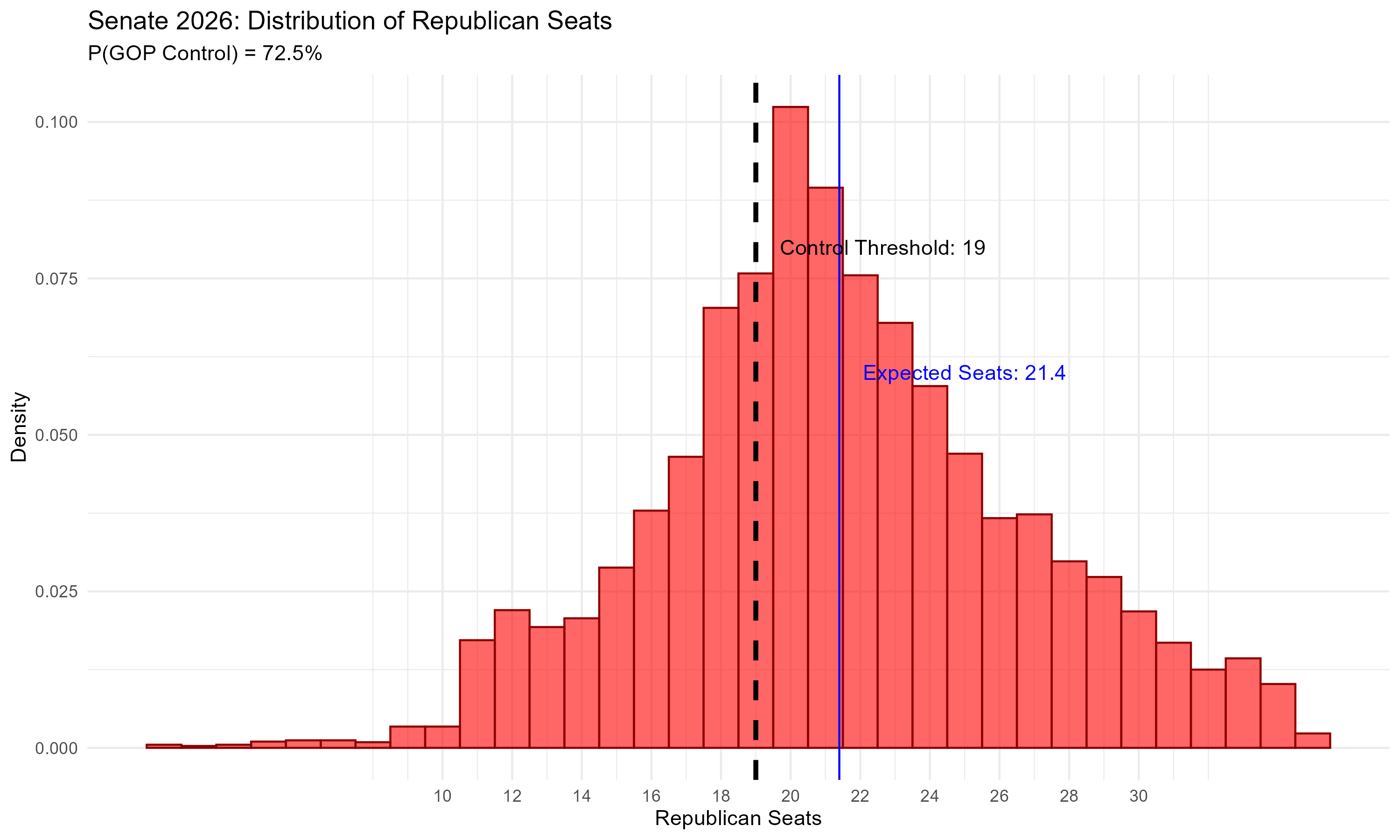
Here’s the headline figure: the model thinks Republicans have about a 72.5% chance of retaining control of the Senate. Of the 35 seats up for election, they will most likely win ~21.4, losing about 1 seat and keeping the rest, on net, giving them a majority of 52. The forecast is visualized below with a histogram of simulated outcomes. But as you’ll see in a moment, there’s good reason to think Democrats have even greater odds than the model suggests.
Before we get into modelling, what might be the consequences of control switching to Democrats?
Who Cares?
Aside from the “big beautiful bill”, which bypassed the filibuster through budget reconciliation, the Senate hasn’t passed much significant legislation. The current administration has preferred to use whatever executive powers are at its disposal, in lieu of a stronger Senate majority that would allow them to override a Democratic filibuster. Such a majority last existed all the way back in 1967. The country has been stuck in a polarized equilibrium ever since, with no real impetus to hand a supermajority to either side. That almost happened in 2008 with the Great Recession, but weird shenanigans involving sick or dead Senators prevented that from materializing.
But even without legislating much, the Senate is still charged with approving Trump’s nominations, including to the Supreme Court. Justice Alito might retire this year, and Democrats could hypothetically delay his replacement until the next Senate is inaugurated, just as Republicans did in 2016. If they acquired a majority in November, Democrats would have more influence on who lands on the court, making the currently 6-3 conservative-liberal court more moderate than otherwise. The court has had immense influence on politics in recent history, like with its recent ruling against Trump’s IEEPA tariffs, forcing him to switch to more temporary tariffs using other laws. Those tariffs are due to expire on July 24th, 150 days after their implementation date of February 24th. The conservative majority also constrained the EPA’s ability to regulate emissions in West Virginia v. EPA.
It’s technically possible to impeach and remove Trump from office, and Democrats would need a strong Senate majority to get the job done. Bettors think there’s a 44% chance Trump leaves office before the end of his term. In that market, money is returned to bettors at the last traded price in the case that Trump dies, since betting on death is a big legal no-no, so the odds reflect the chances Trump resigns or gets impeached and convicted. I think these odds are way too high, so I’ve happily bet $50 on “No” in the market giving him a 44% chance of leaving before the end of his term.
Why do I think these odds are very silly? Two reasons:
Trump resigning seems out of the question. Nixon is the only president to have resigned in American history, and that was after getting into extreme legal trouble with the Watergate scandal. In other words, he resigned because he knew he would be impeached and convicted. In lieu of that, Trump appears too prideful to resign, and even if he isn’t, there will be constant pressure from Republicans to not resign, since Trump is immensely popular among Republican voters and seems to help other Republicans get elected.
The country is too polarized to pull off an impeachment and conviction. Democrats already tried this twice before, and it didn’t work either time. Why? Because we’re too polarized. Modern politics revolves around ideological enforcement through the primary system, and that means many Republican Senators who might vote to convict Trump would get punished for it by the more partisan voters who show up in the primaries, even if the median voter agrees that conviction is preferable.
As a reminder, you need 671 Senators to convict a president. A majority that large is impossible for Democrats, so they’d need a ton of Republican votes.
There’s also the question of “What would they even impeach him for?”, but I don’t think that’s much of a problem. Impeachment is a political procedure, so the only binding constraint on Democrats is whether they can pick out something Trump did that is unpopular enough for voters to agree it’s worth impeaching him over. That’s really what bettors are thinking might happen: Trump does something so incredibly bad that he becomes massively unpopular and breaks through the floor of ~35-40% favorability he has always managed to get since he was elected in 2016:
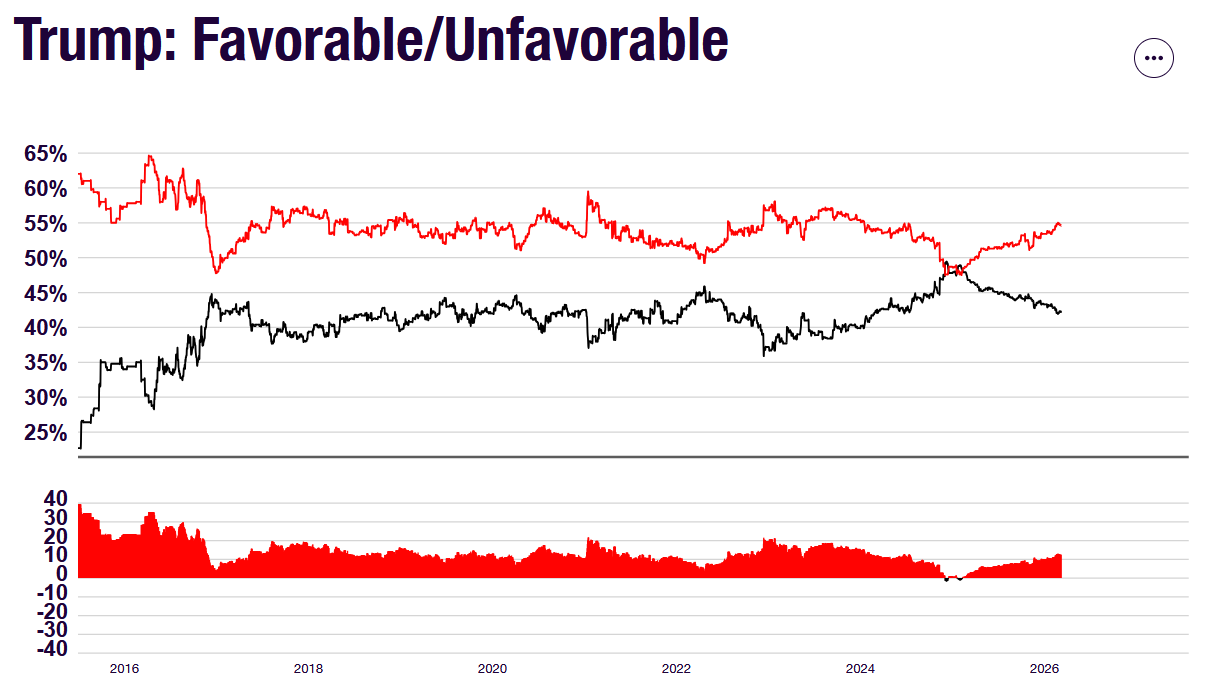
Considering that even January 6th wasn’t enough to make Trump that unpopular, I don’t think anything will ever bring him down through that popularity floor. He’s here to stay until the end of his term (or his death).
So, Democratic control of the Senate won’t have much bearing on whether Trump leaves office early. It will matter for Supreme Court nominations, and will also prevent Republicans from using budget reconciliation to change taxes and spending any more than they already have.
How Has the Model Changed?
I’ve recently worked on updating the model to be a little more sensible. In order of impact on the forecast:
When too few polls are available, vote share estimates are blended with the current generic ballot margin.2 Generic ballot polls ask voters across the country which party they intend to vote for, and give us an idea of whether the current cycle is unusually red or blue.
The prior vote share forecasts for each state are now more empirical. (You might recall that these priors are used to forecast votes when no polls are available, and are blended with polls to get the final estimates.) A couple of regressions revealed that a weighted average of the last Senate and presidential results in a state is more predictive than using the last presidential result on its own. Thus, the new priors are weighted averages that are 80% presidential results and 20% Senate results.
Demographic variables, used to characterize how outcomes in each state tend to correlate with one another, have been updated from 2013 ACS estimates to 2024 ACS estimates. This didn’t matter at all, but it was worthwhile to check.
Other Forecasts
The most popular election forecasters, like Nate Silver and G. Elliott Morris, have yet to publish their models for this year. But some forecasters get started early: Race to the White House has a Senate model, and they currently give Republicans a 57.1% chance to retain control of the chamber. To understand why they’re more optimistic for Democrats, let’s focus on one race: Ohio, which will be holding a special election on account of JD Vance’s resignation from his seat. Ohio Governor Mike DeWine nominated Jon Husted to replace Vance, but Husted still needs to face a real election.
The likely nominee for the Democratic Party in Ohio will be Sherrod Brown, who previously served as a Senator from Ohio from 2007 to 2025. He lost his seat to Bernie Moreno in 2024. Brown and Husted will each need to acquire their party’s nomination in the May 5th primary elections there.
Right now, we don’t have that many polls checking what Ohioans think of the two candidates in a head-to-head contest, and a lack of data will tend to poison a model like the one I’ve built. With only two polls out of Ohio, it falls back on the prior and adjusts it slightly for the current generic ballot margin, which puts Democrats 4 points ahead. Thus, the Republican prior is moved 2 points lower, and the Democratic prior is moved 2 points higher, shifting the estimated margin from R+10 to R+6. The model thus gives Husted a 74% chance to win.
But Brown’s past performance and familiarity to voters—which the model doesn’t consider—is strong evidence in his favor. Incumbent Senators tend to get a “bonus” from their incumbency, and part of this is their experience as legislators.3 That means the incumbency bonus partially applies to a former Senator like Brown. It drops to near zero for appointed Senators like Husted: they win about 54% of the time when they run, not much better than coinflip odds.
Hence, even though Ohio is a red state where we have little polling data, we have good reason to believe Brown has much better than the 26% chance the model gives him. A similar story can be told in other states like Alaska, where the likely Democratic nominee is Mary Peltola, who has experience winning Alaska’s single US House seat in 2022 before narrowly losing it by 2.44 points in 2024. That suggests that Peltola can win in spite of Alaska being a red state where most Democrats would struggle.
I could do something silly, like add an extra point or two to every candidate who has more experience than their opponent, but I prefer to work on this a little more until I have a more empirical way to include this extra information. For now, betting markets give Brown a much higher 45.5% chance to win, and they give Democrats a 44.5% chance to win control. So long as polling data is scant, they’ll be able to include information the model cannot include in its current form, even implicitly.
So, I’d better get back to work! In the meantime, you can bookmark jacksforecasts.com and check it once a week. Starting this week, I’ll be updating it every Tuesday.
Yes, we’re all noticing the number. This will stop being funny at some point.
Specifically, this happens when the median sample size of all polls released from a state in the past 180 days, multiplied by the number of polls in the past 180 days, is less than 2000.
See here, page 876. Their regression doesn’t appear to separate experience from being a current office holder, but this seems obvious enough that I won’t bother to spend a lot of time on this point.
“Trump is immensely popular among Republican voters and seems to help other Republicans get elected.”
Ah, but only when HE’S on the ballot; otherwise, he’s been an electoral drag in ‘18 and ‘22.